There are lost cities buried beneath jungle. Nan Madol went one better and built itself in the sea.
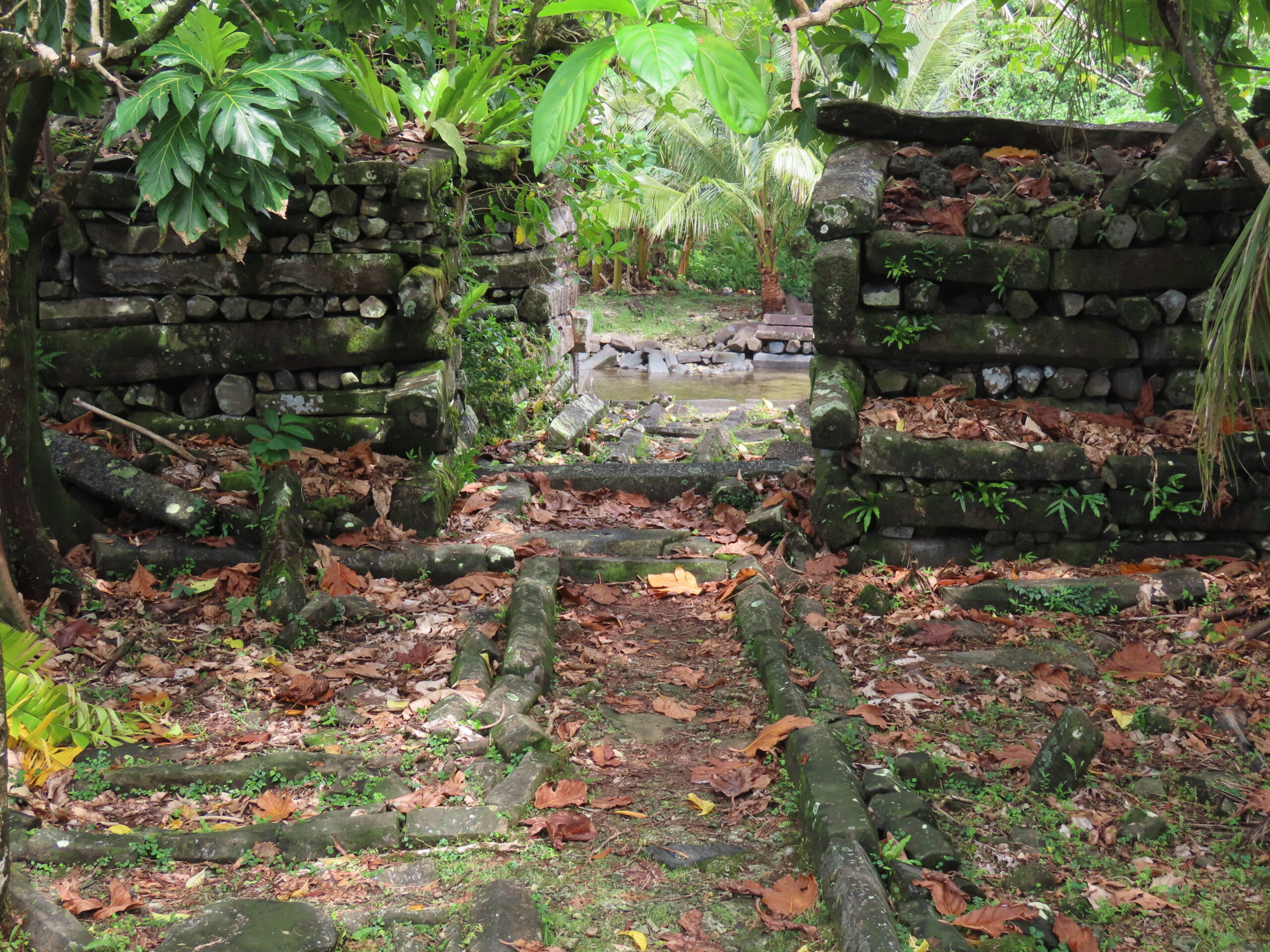
Off the south-east coast of Pohnpei, in the Federated States of Micronesia, more than 100 artificial islets sit inside a lagoon. Between them run tidal channels. On them stand the remains of palaces, temples, tombs and houses assembled from enormous lengths of dark volcanic basalt.
It looks less like a ruin than the abandoned set of a civilisation somebody forgot to explain.
Except Nan Madol was real.
UNESCO dates the great ceremonial centre of the Saudeleur dynasty principally to between 1200 and 1500. Its builders hauled columnar basalt from elsewhere on Pohnpei and stacked it in alternating courses, sometimes described as looking like giant logs laid across one another. Some individual stones weigh many tonnes.
The engineering is impressive enough. The setting makes it ridiculous.
The city was constructed on a coral reef.
Within the intervals
Nan Madol roughly means “within the intervals”, a reference to the waterways separating its islets. At high tide, the logic of the place becomes clearer: this was a city whose streets were water.
Its most formidable surviving structure is Nandauwas, a royal mortuary complex enclosed by towering basalt walls. Elsewhere were residences for chiefs and priests, ceremonial areas and domestic spaces. Nan Madol was not an eccentric pile of stones. It was the political and religious centre of a sophisticated Pacific society.
What survives is enough to explain why UNESCO placed it on the World Heritage List in 2016 – and simultaneously on the List of World Heritage in Danger. Mangroves, siltation, storms and collapsing masonry are slowly working on a city that has already survived centuries.
Local oral traditions add another layer. Stories tell of supernatural power used to move the stones. Archaeology gives us human organisation, quarrying and extraordinary engineering instead, but not a neat construction manual.
That gap between what can be seen and what can be completely explained is part of Nan Madol’s pull.
The SideQuest
Pohnpei is not somewhere you accidentally end up.
Flights reach the island through the Pacific, including United’s Island Hopper connections through Honolulu and Guam and Nauru Airlines services through the region. From Pohnpei’s main settlements, Nan Madol lies on the opposite side of a mountainous, famously wet tropical island.
The ruins are on private land but open to visitors. You can approach overland, timing the visit around the tide and expecting wet feet, slippery stone and uneven ground. Or you can do what makes far more sense for a city designed around canals and approach with a local boat or kayak guide.
That matters because Nan Madol is not an archaeological theme park. It remains culturally significant to Pohnpeians and is connected to traditional authority that continues today. A guide is useful for more than navigation.
From the water, the walls emerge between mangroves and the scale begins to register. Thousands of tonnes of basalt. Artificial islands. A city built into a lagoon on a remote Pacific island centuries before European contact.
People sometimes call Nan Madol the Venice of the Pacific.
Forget Venice.
Venice has spent centuries explaining itself.
Nan Madol is better because it still makes you wonder.