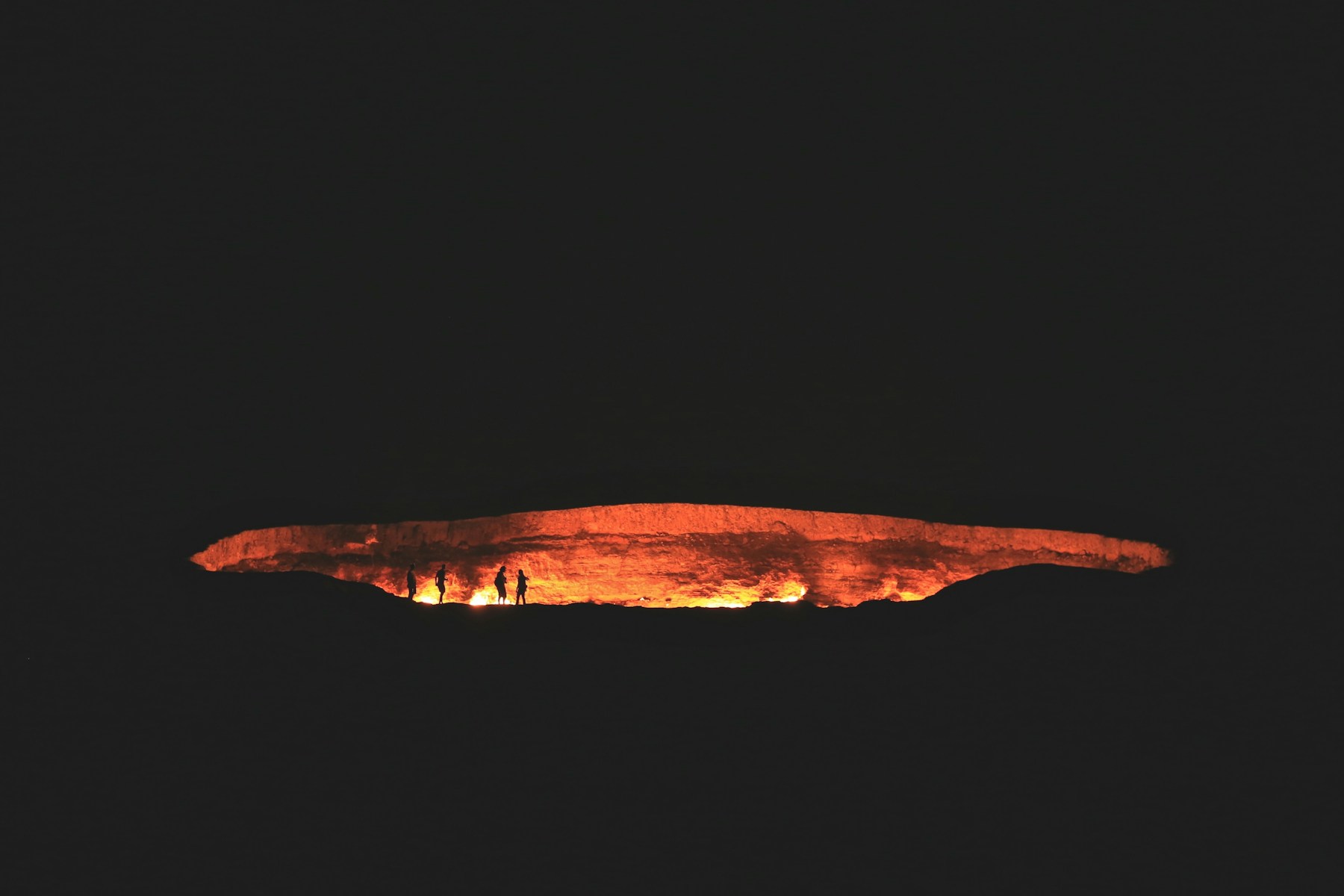
For decades, the best time to arrive at Darvaza was just before sunset.
In daylight it was an ugly hole in the Karakum Desert. Then the sun went down and the earth turned orange.
Hundreds of flames burned across a crater roughly 60 metres wide, fed by natural gas leaking from beneath the desert. The heat reached the rim. The glow could once be seen from kilometres away.
Somebody inevitably named it the Gates of Hell.
The surprise in 2026 is that hell is apparently being turned down.
Turkmen authorities have been diverting gas into nearby wells as part of efforts to reduce methane emissions. State energy officials say the intensity of the burning has fallen by roughly three times since 2023. Where the crater once blazed across much of its floor, recent accounts describe smaller pockets of flame.
Darvaza is still burning.
But for the first time in decades, travelling there comes with a strange new question: how much longer will it?
A very Soviet mystery
The famous origin story is irresistible. Soviet geologists drilling for gas in 1971 supposedly broke into an underground cavern. The ground collapsed beneath their rig. Gas began escaping. Engineers set it alight, expecting the fuel to burn out in a few weeks.
Fifty years later, tourists were still standing around it.
There is only one problem. The history is murkier than the legend.
Records are incomplete and competing accounts put the crater’s formation in the 1960s and its ignition later. Even recent sources disagree on the exact year. What is certain is simpler: a drilling-related collapse exposed natural gas, somebody lit it, and an industrial accident became one of Central Asia’s strangest tourist attractions.
For years the remoteness did half the work. Darvaza sits in the Karakum, hundreds of kilometres from Ashgabat, surrounded by an enormous desert and reached overland rather than by strolling from a hotel lobby.
The SideQuest
Turkmenistan makes you earn this one before you even reach the sand.
Tourists generally need a visa supported by a Letter of Invitation arranged through a travel agency. The country’s own embassy guidance directs tourist applicants to an agency for that paperwork. In practice, that makes Darvaza a guided expedition rather than a spontaneous road trip.
Current operators run trips from Ashgabat and from the Uzbek border, usually in four-wheel-drive vehicles. The best versions stay overnight near the crater in a tent or yurt.
That is still the way to do it.
Arrive in daylight and the place can seem almost disappointing: bare desert, a scar in the ground, scattered infrastructure. Wait.
As the sky darkens, the remaining flames sharpen. Heat shimmers above the pit. The desert around it disappears. There are few experiences quite like standing in darkness while the ground itself burns.
Then walk away from the rim, eat dinner in the desert and come back later when everyone has stopped taking photographs.
Darvaza’s great trick was always that something created by industrial error became weirdly elemental – earth, gas, fire and darkness.
Now there is an ending being written into it.
The engineers who first lit the gas, whenever exactly that happened, thought the fire would soon go out.
They may finally be right.